Is Intraday Trading Gambling or a Skill? The Truth Nobody Tells You
Opinion Trading > Betting > Is Intraday Trading Gambling or a Skill? The Truth Nobody Tells You
If your trade has ever gone wrong within minutes, you have probably asked yourself this: is intraday trading gambling?
To be honest, it is a very fair question. On the surface both look similar. You put in money. You take a risk. You win or lose.
But the reality is more complex than that.
In this article I want to break down exactly where trading and gambling differ and how these are related. You will also learn about why many traders end up treating the markets like a casino without even realizing it.
And most importantly, how you can make sure you are on the right side of that line.
Because that one distinction can completely change your approach to the markets.
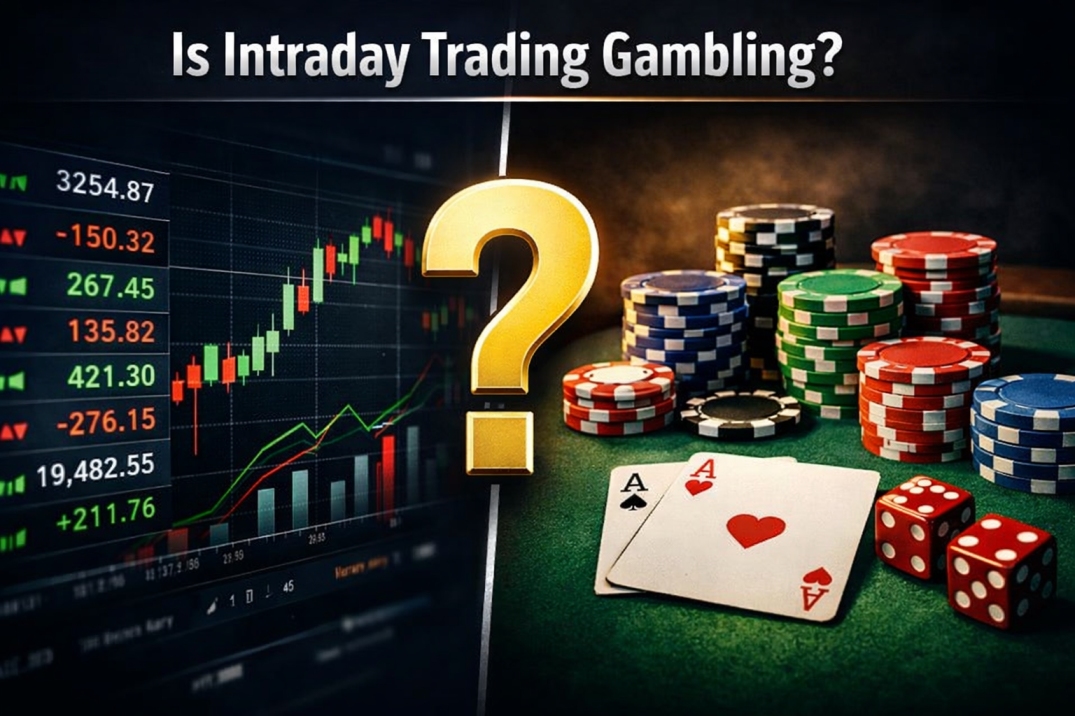
Is Intraday Trading Gambling?
No, intraday trading is not gambling as it is based on analysis, strategy and risk management. Traders study charts, track market trends and make calculated decisions before investing any money. However, if someone is blindly putting money on intraday trading, it seems like gambling.
It should be noted that the trading market does not care about luck. It responds to data, sentiments, and price movements. A disciplined trader learns to read these signals. A gambler ignores these signals and simply hopes for the best or luck.
What is Intraday Trading?
Intraday trading is the practice of buying and selling financial instruments within the same trading day. All positions are closed before the market shuts down, with no trades carried overnight.
In simple words, you enter a trade and exit it the same day whether you make a profit or a loss. Let us understand this concept with a simple example.
Example: Say you buy 100 shares of Apple at $175 at 9:30 AM. By 1:00 PM the price moves to $178. You sell and make $300 in just a few hours. That is intraday trading.
You do not need to wait months or years to see returns. But that speed works both ways; Profits can come quickly and so can losses. That is exactly why understanding it properly matters before putting any money in.
Intraday trading looks like gambling because of uncertain outcomes, emotional decision making and the absence of a proper strategy. Honestly, for many people it does feel that way. And there are very real reasons behind that feeling.
The outcomes are uncertain. No matter how much you analyze, the market can turn against you without warning. A single news headline, a global event or even a rumor can change everything within seconds.
The excitement also feels very similar. Watching your position move up and down creates an adrenaline rush that many traders get addicted to. They start chasing that feeling rather than focusing on actual returns.
And the numbers are hard to ignore. Studies suggest that nearly 70 to 80 percent of intraday traders lose money consistently. Not because the market is unfair but because most people jump in without any real strategy or plan.
When you are putting money based on a gut feeling or a tip from a WhatsApp group, that is not trading. That is gambling with extra steps.
But How Is Intraday Trading Different From Gambling?
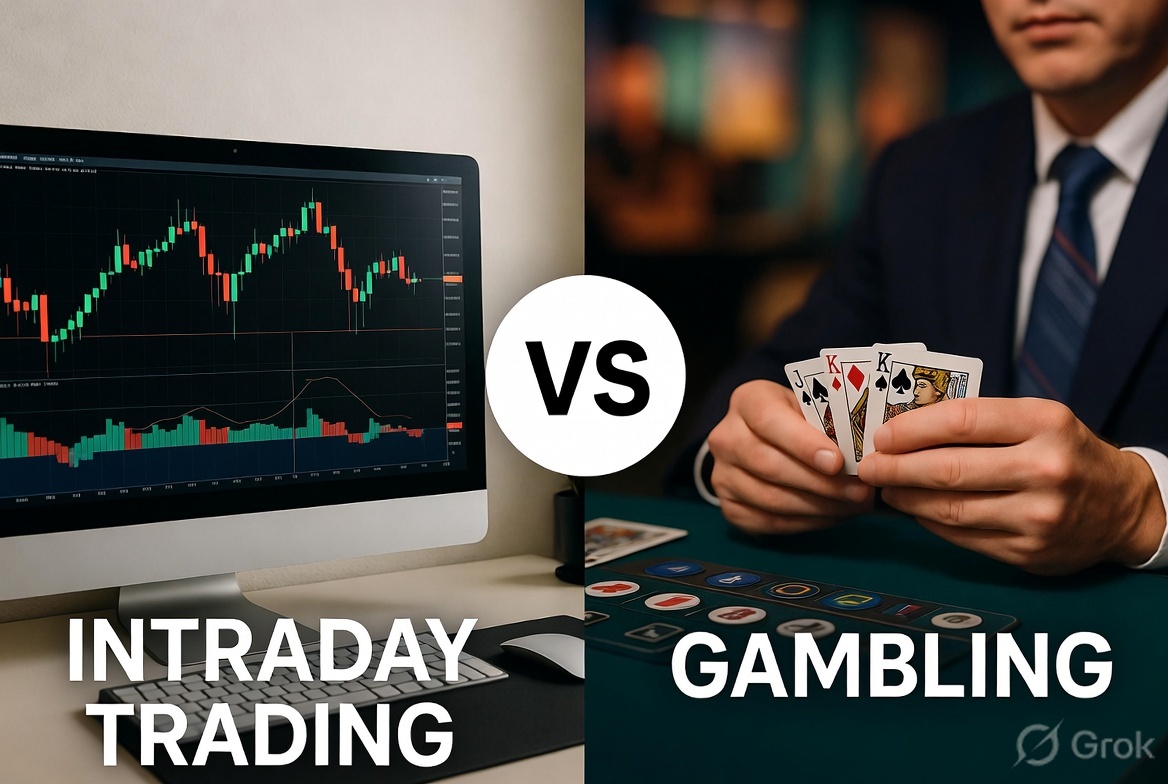
The core difference is simple. Intraday trading is skill-based. Gambling is purely chance-based.
In gambling the odds are always fixed against you. A casino is designed so that the house wins over time. No amount of practice or knowledge can change that reality.
Intraday trading works differently.
A skilled trader uses technical analysis, price actions, volume data, and market trends to make informed decisions. They set stop losses before entering any trade. They follow a defined strategy and do not let emotions drive their moves.
Over time a disciplined trader can develop a consistent advantage. That advantage is what separates trading from gambling. In gambling no such edge exists. In trading, it can absolutely be built through knowledge, patience and practice.
Before entering any trade, it is essential to have discipline, a plan, and a clear understanding of your limits in order to maintain your safety when engaging in intraday trading. Here is what actually makes a difference:
Always use a stop loss – Decide before entering any trade how much you are willing to lose. If the price hits that level, exit immediately. No hoping, no waiting.
Never trade with money you cannot afford to lose – Using emergency funds or borrowed money is one of the fastest ways to turn trading into a serious financial problem.
Avoid acting on tips – Whether it comes from social media, YouTube or a WhatsApp group, a tip without logic is just noise. Always understand why you are entering a trade before you enter it.
Start small – If you are new, trade with small quantities first. Focus on learning rather than earning in the early phase.
Maintain a trading journal – Write down every trade, why you entered, what happened and what you learned. This single habit can improve your decision-making faster than any course.
Bonus Tips: Trade only during the first and last hour of the market if you are a beginner. That is when the most volume and movement happens and setups are clearest. Always keep emotions out of your decisions.
Remember, fear and greed are the two biggest reasons traders consistently lose money.
Conclusion
So, is intraday trading gambling? The direct answer is no, but it depends entirely on how you approach it.
As an activity, intraday trading is skill based. It rewards preparation, discipline and continuous learning. But when approached without strategy, without risk management and driven purely by emotion or tips, it becomes gambling in every practical sense.
The market does not judge anyone. It simply responds to data and sentiment. Your job as a trader is to study those signals and make informed decisions consistently.
If you treat it seriously, protect your capital and keep learning, intraday trading can be a legitimate way to participate in the markets.
But if you are looking for quick money without preparation, the market will teach you an expensive lesson. And it usually does not take long.
Salvator Jordan has been involved in online betting & iGaming for the past three years and has a thorough understanding of market operations. Salvator shares his experience and success tips for betting apps, iGaming, & fantasy sports on OpinionTrading.in.