Updated April 2026 | Covers all 50 states, federal law, bet types, top platforms, and how to get started
Key Takeaways
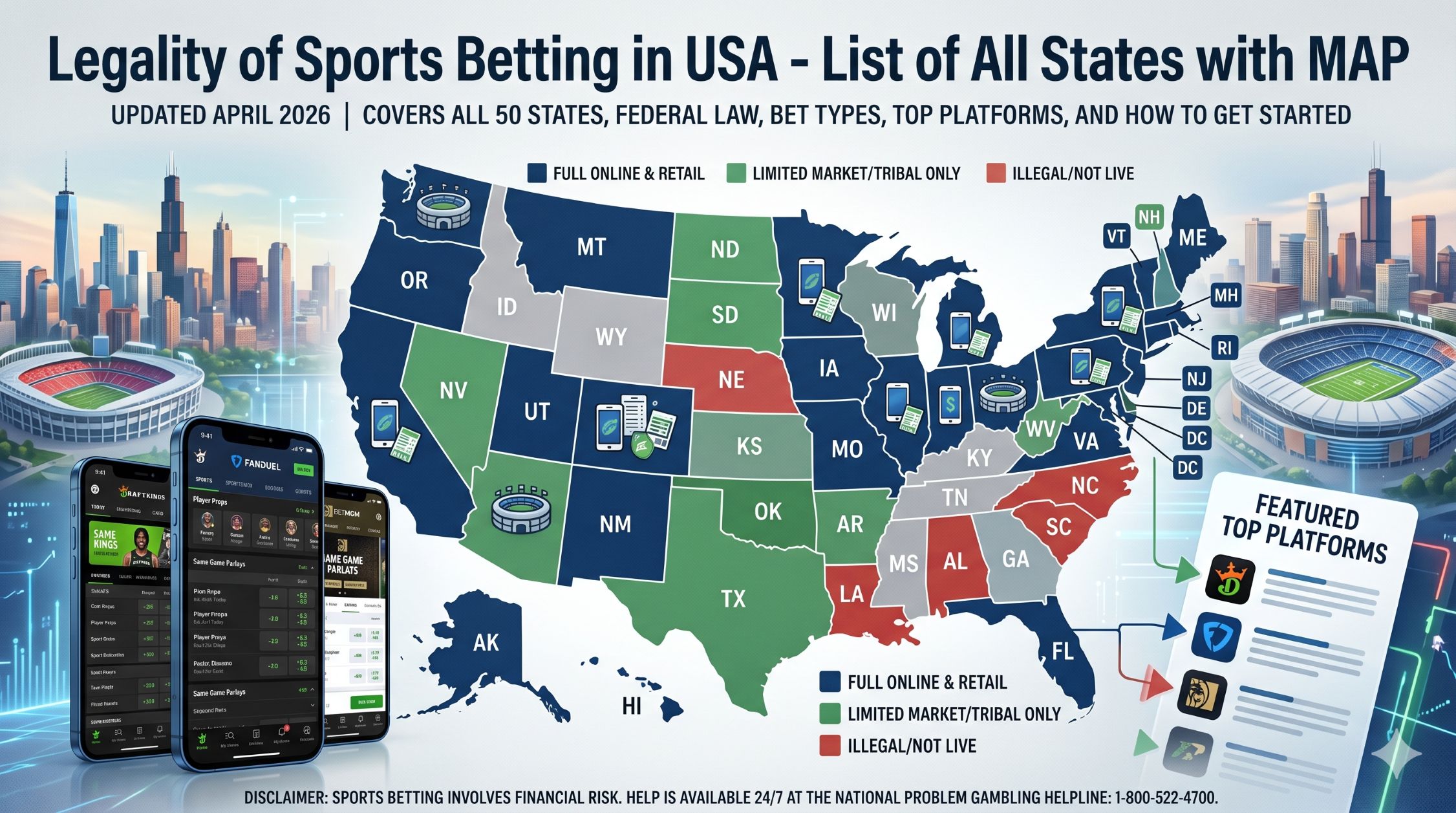
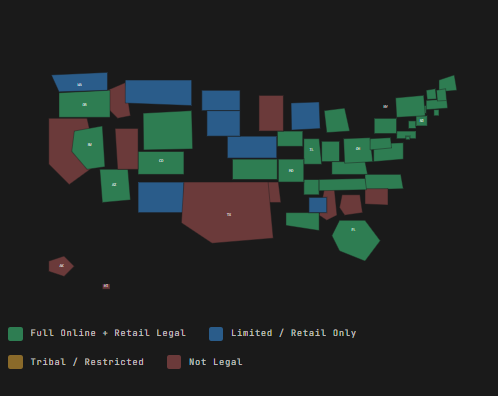
Sports betting is legal in 39 states of USA plus Washington D.C. and Puerto Rico with more than 30 of those offering full statewide online access. It remains illegal in 11 states, most notably California, Texas, and Georgia, though all three have active legalization efforts underway.
The federal government does not operate or directly regulate the industry; each state builds its own framework. For bettors in legal states, the process is straightforward: choose a licensed platform, verify your identity, deposit funds, and wager legally through a regulated app.
Federal Legal Framework for Sports Betting in USA
Sports betting in the US is not governed by a single federal law. There is no nationwide licensing system, no federal sportsbook regulator, and no uniform set of rules. What exists instead is a patchwork of state laws each state sets its own rules, taxes, and licensing requirements.
Three federal laws form the backbone of that framework.
Interstate Wire Act of 1961
The oldest relevant federal statute is the Wire Act which makes it a federal crime to use wire communications, originally telephone lines. Its original target was organized crime’s bookmaking networks. The primary reason that every legal sportsbook app requires your physical location to be verified inside a legal state before accepting a wager.
You cannot use a New Jersey sportsbook account while sitting in Texas. The bet must be placed and received within the borders of a state that has legalized it.
PASPA: The 1992 Federal Ban
In 1992, Congress passed the Professional and Amateur Sports Protection Act (PASPA) which effectively created a nationwide prohibition on state-sponsored sports betting. PASPA did not make sports betting a federal crime for individuals; it blocked states from authorizing or licensing it.
For 26 years, PASPA kept sports betting in legal limbo. Offshore online books and local bookmakers wagered billions of dollars each year, while Nevada maintained a legal monopoly on the market.
The UIGEA (2006)
The Unlawful Internet Gambling Enforcement Act of 2006 did not directly ban online gambling. Instead, it targeted the financial plumbing that funds it. Also, prohibiting banks and payment processors from handling transactions with unlicensed gambling sites.
This is why offshore sportsbooks have historically struggled with deposits and withdrawals for American customers and why legal state-regulated books are connected to licensed, transparent payment systems.
2018 Supreme Court Decision That Changed Everything
New Jersey had been fighting PASPA in court since 2012. The state wanted to authorize sports betting at its casinos and racetracks, a cause championed first by Governor Chris Christie and later by his successor Philip Murphy. The case eventually reached the Supreme Court as Murphy v. National Collegiate Athletic Association.
On May 14, 2018, the Court ruled 6–3 that PASPA was unconstitutional. Writing for the majority, Justice Samuel Alito held that the law violated the anti-commandeering doctrine of the Tenth Amendment: Congress cannot direct state legislatures to maintain laws they might not want.
The effects were immediate. New Jersey launched sports betting within weeks. Delaware, Mississippi, West Virginia, and several others followed within months. The number of legal states has grown nearly every year since.
Today, there are 39 states plus Washington D.C. and Puerto Rico that have legalized sports betting in some form. More than 30 of those offer full statewide online and mobile betting. The total amount wagered by American bettors in 2025 surpassed $130 billion — a figure that would have seemed impossible before 2018.
The SAFE Bet Act (Proposed 2024)
Federal interest has not gone dormant. In September 2024, Representative Paul Tonko and Senator Richard Blumenthal introduced the SAFE Bet Act which would impose national minimum standards on sports betting advertising.
It also requires affordability checks, regulate the use of artificial intelligence in sportsbook algorithms, and ban prop betting on college athletes. As of early 2026, the bill has not advanced to a vote but it signals growing Congressional attention to industry practices.
Where Sports Betting Is Legal in USA— State by State
The legal landscape falls into four categories: states with full online and retail betting, states with limited or retail-only markets, states with tribal-only options, and states where it remains illegal entirely.
States With Fully Online Betting in USA
Arizona — Legal since September 9, 2021. Both online and retail. Regulated by the Arizona Department of Gaming. Currently there are 14 licensed sportsbooks, including some of the country’s first in-stadium betting locations. Online revenue taxed at 10%.
Arkansas — Retail since July 2019, online since March 2022. Regulated by the Arkansas Racing Commission. Three operators. Revenue taxed at 13% on the first $150 million and 20% above that threshold.
Colorado — Online and retail since May 1, 2020. One of the first states to launch after the 2018 ruling. 10% tax on adjusted gross revenue. Competitive market with multiple operators.
Connecticut — Online and retail since October 2021. A hybrid model combining tribal operators (Mohegan Sun, Foxwoods) with commercial operators.
Delaware — First state outside Nevada to legalize sports betting, launching retail on July 5, 2018, and adding online on December 26, 2023. Wagering on in-state college games is prohibited, as are player props on college athletes.
Florida — A unique case. Sports betting operates through a compact between the state and the Seminole Tribe of Florida. After years of legal battles, it re-launched in November 2023. The Hard Rock Bet app is currently the only legal online sportsbook in the state.
Illinois — Retail since March 2020, online since June 2020. Ten online sportsbooks are currently operational. Governor Pritzker enacted a tax hike in June 2025. Betting on in-state college games and player props on college athletes is prohibited.
Indiana — Online and retail since September 1, 2019. Eleven online sportsbooks are available. No player props are permitted for college athletes.
Iowa — Online and retail since August 15, 2019. Eleven online sportsbooks. No player puts props on college athletes.
Kansas — Online and retail since September 1, 2022. Six online sportsbooks. No college athlete player props.
Kentucky — Online and retail since September 28, 2023. The horse racing state embraced sports betting after years of advocacy.
Louisiana — Online since January 2022. A parish-by-parish system determines where retail betting is permitted. Online tax rate increased in June 2025.
Maine — Legal since November 2023. Smaller market with full online access.
Maryland — Online since November 2022. Tax rate increased to 20% in May 2025.
Massachusetts — Online since March 2023. Betting on in-state college teams is prohibited.
Michigan — Online since January 22, 2021. One of the few states that also legalized online casino gaming alongside sports betting.
Missouri — The newest market. Voters approved a constitutional amendment in November 2024 by a razor-thin margin of 0.1%. Both online and retail sports betting launched December 1, 2025, under the Missouri Gaming Commission. Adults 21 and older can bet through licensed apps and approved retail locations.
Nevada — The original legal market, operating decades before the PASPA repeal. Nevada launched the first online sports betting in the country in October 2010. Nevada continues to set the standard for the industry.
New Hampshire — Online since December 2019. A single-operator model is run through a DraftKings partnership with the state lottery.
New Jersey — The state that fought PASPA all the way to the Supreme Court. Launched retail and online betting in June 2018 and has been one of the most competitive markets ever since, with 12 or more active sportsbooks.
New York — Online since January 8, 2022. New York has the highest tax rate on online sports betting in the country at 51%, which has reshaped how operators approach the market. Despite the rate, New York generates enormous betting volume given its population.
North Carolina — Online since March 11, 2024, making it the 30th state to launch statewide online betting.
Ohio — Online and retail since January 1, 2023. One of the fastest-growing sports betting markets in the country.
Oregon — State lottery operates a DraftKings partnership. Online and retail are available.
Pennsylvania — Online and retail since May 2019. One of the most competitive markets, though operators face a 36% tax rate on online revenue.
Rhode Island — Online since September 2019. State-managed model.
Tennessee — Online since November 1, 2020. Tennessee is notable for being online-only — no retail sportsbooks are permitted under state law.
Vermont — Online since January 11, 2024. Online only; no brick-and-mortar sportsbooks.
Virginia — Online since January 2021, retail since 2022. Strong regulatory framework with multiple operators.
Washington D.C. — Multiple online operators were approved following a 2024 budget decision by the D.C. City Council.
West Virginia — One of the earliest adopters after the PASPA repeal. Online and retail since September 2018.
Wyoming — Online and retail since September 2021. Wyoming allows online-only operators without a physical presence requirement — an unusual model.
Limited or Restricted Sports Betting in USA
Some states allow sports betting only under specific, narrow conditions.
Mississippi — Retail wagering at licensed casinos is permitted, and mobile betting exists — but only on casino property. You cannot use a sportsbook app from home in Mississippi.
Montana — The state lottery partnered with Intralot to offer sports betting through an app, but the app only works at authorized Montana Lottery terminal locations. It does not function as a statewide mobile platform.
Nebraska — Retail only at licensed horse racing tracks. No statewide online betting.
New Mexico — Tribal sportsbooks operate under existing Class III gaming compacts. No commercial sports betting or statewide online platform.
North Dakota — Tribal sportsbooks only, operating under existing gaming compacts.
South Dakota — Retail only at licensed facilities in Deadwood. No statewide mobile access.
Washington State — Tribal in-person betting only. No commercial operators or statewide mobile betting.
Wisconsin — Tribal in-person only under gaming compacts. Repeated legislative efforts to expand have not succeeded.
US States Where Sports Betting Is Illegal
In USA, 11 states have no legal sports betting framework: Alabama, Alaska, California, Georgia, Hawaii, Idaho, Minnesota, Oklahoma, South Carolina, Texas, and Utah.
Utah has a gambling prohibition written directly into its state constitution, with roughly two-thirds of residents opposing any gambling expansion. It is widely regarded as the state least likely to ever legalize sports betting.
Hawaii similarly bans nearly all forms of gambling. Multiple bills were introduced in 2025 but none passed before the legislative deadline.
California is the most consequential holdout — the largest state by population, with a market that could rival New York and New Jersey combined. Two major ballot initiatives failed in the November 2022 election. The central obstacle is a deep dispute between tribal gaming interests which want a retail-only model, and commercial operators.
Texas requires a constitutional amendment to permit sports betting — legislation must pass both chambers of the legislature and then be ratified by voters in a statewide election. Bills passed the Texas House in 2023 and 2025 but stalled in the Senate each time. The next legislative session creates another opportunity.
Georgia has come close. In 2025, a House committee passed a sports betting bill, but it ran out of time before the end of the legislative session. Georgia is among the states most likely to legalize in the near term.
Minnesota has shown momentum in recent years but has consistently hit a wall over tribal gaming negotiations. An agreement between the state and its tribal nations is the key prerequisite.
Oklahoma demonstrated progress in recent years but has consistently faced challenges due to not having been able to pass legislation satisfying both tribal interests and commercial ambitions.
Types of Sports Bets Available in the US
Legal sportsbooks in the US offer a broad menu of wagering options. Here is a plain-language explanation of each major type.
Moneyline
The simplest form of sports betting: pick which team or player wins outright. American odds are expressed as positive or negative numbers. A negative number (for example, −150) means you must risk that amount to win $100. A positive number (for example, +130) means a $100 bet profits that amount. Moneylines are the primary format for baseball and hockey, where scoring margins are smaller and the point spread is less meaningful.
Point Spread
The favorite must win by more than the spread; the underdog must either win outright or lose by less than the spread to “cover.” Standard juice (the sportsbook’s commission) on spread bets is −110 on both sides, meaning you bet $110 to win $100. The point spread is the dominant format for NFL and NBA betting, where scoring gaps between teams can be significant.
Over/Under (Totals)
A bet on whether the combined final score of a game will be over or under a number set by the sportsbook. Your choice has nothing to do with which team wins — purely about total points, runs, or goals scored. Like spread bets, standard juice is typically −110 on both sides.
Parlay
A parlay combines two or more individual bets into a single wager. Every leg of the parlay must win for it to cash. The tradeoff is higher risk – one loss kills the entire ticket but significantly higher reward. Odds multiply across each leg. A winning three-leg parlay at even-money odds, for instance, turns a $10 bet into roughly $70.
Same-Game Parlay (SGP)
A parlay where all legs come from the same game — combining the spread, total, and individual player props into one ticket. Popularized by FanDuel and now standard across all major platforms. SGPs are particularly popular for NFL Sunday games and NBA matchups.
Prop Bets (Proposition Bets)
Wagers on specific events within a game that do not directly determine the final result. Player props ask things like: Will this quarterback throw for over 280 yards? Will this player score the first touchdown? Team props might ask whether a team will score in the first quarter.
Futures
A futures bet is placed well in advance of an event’s conclusion which team will win the Super Bowl, who will win the NBA MVP, which team finishes first in their division. Odds shift throughout the season as performances and circumstances change. Early-season futures can offer excellent value but require patience as your money is tied up for months.
Live/In-Play Betting
Live betting allows wagers while the game is in progress, with odds updating in real time based on the current score, time remaining, and game situation. You can bet on the next scoring play, whether a team will cover from a current deficit, or the final outcome — all while the action unfolds. Offered by all major sportsbooks on NFL, NBA, MLB, and most major soccer leagues.
Teaser
A modified parlay that lets you move the point spread a set number of points typically 6, 6.5, or 7 in football in your favor across multiple games. You gain a more favorable line on each game in exchange for a reduced payout compared to a standard parlay. Common in football betting where key numbers (3 and 7, the values of a field goal and touchdown) make specific spread movements particularly valuable.
How to Legally Bet on Sports in USA: Step-by-Step
If you are located in a USA state with legal online sports betting, the process is straightforward. Here is exactly what you need to do.
Step 1: Confirm you are in a legal state. Legal sportsbooks use GPS and IP verification to confirm your physical location before accepting any bet. Being a resident of a legal state does not matter if you are physically in a non-legal state when you try to place a wager.
Step 2: Meet the age requirement. The minimum age is 21 in most states. A handful of states including Montana, Rhode Island, Washington D.C., and New Hampshire allow betting at age 18. You will need to verify your identity with a government-issued ID during registration.
Step 3: Choose a licensed platform. Only use sportsbooks licensed by your state’s gaming commission. The major nationally licensed operators are DraftKings, FanDuel, BetMGM, Caesars, bet365, and Fanatics. Download the app or go to the official website. Avoid offshore, unlicensed sites, they operate illegally in the US and offer no consumer protections if something goes wrong.
Step 4: Create and verify your account. Registration requires your legal name, date of birth, address, and the last four digits of your Social Security Number for identity verification. This is required by law. Accounts are typically approved within minutes. You cannot hold multiple accounts at the same sportsbook.
Step 5: Make a deposit. Legal sportsbooks accept debit cards, PayPal, Venmo, online bank transfers (ACH/e-check), and cash via PayNearMe at participating retail locations. Some accept credit cards, though not all. Most deposits are instant. Minimum deposits are typically $5 to $10.
Step 6: Claim your welcome bonus. Most platforms offer a new-user promotion — typically either a “bet and get” offer (for example, bet $5 and receive $200 in bonus bets if your bet wins) or a first-bet insurance offer (for example, get up to $1,500 back as bonus bets if your first bet loses).
Step 7: Place your bet. Browse the sport, league, and game you want. Click on the odds you like they populate your bet slip automatically. Enter your wager amount, review the potential payout, and confirm. Winnings are credited to your account automatically when the event settles.
Step 8: Understand your tax obligations. All gambling winnings in the US are taxable federal income, regardless of amount. Sportsbooks are required to issue you a W-2G form for certain large wins, but you are legally required to report all gambling income on your federal tax return, even without that form. Keep records of your wins and losses throughout the year.
Top Licensed Sports Betting Platforms in the US
Dozens of sportsbooks are licensed across various states in USA but a handful of national operators dominate the market. Here are the six most widely available and consistently well-regarded platforms as of 2026.
DraftKings
Started as a daily fantasy sports platform in 2012, DraftKings launched its sportsbook in 2018 following the PASPA repeal. It has since grown into what many analysts rank as the top sports betting app in America. DraftKings is known for its clean, intuitive interface, competitive NFL and NBA odds, deep same-game parlay options, and fast live betting. Available in more than 25 states.
FanDuel
FanDuel’s app is consistently praised for its user experience; fast, clean, and easy to navigate. It is particularly strong for live streaming integration alongside in-play wagering, and its same-game parlay product is among the best in the industry. FanDuel also offers strong ongoing promotions for returning users, not just new sign-ups. Available in more than 25 states.
BetMGM
A joint venture between MGM Resorts International and Entain, BetMGM launched in 2018 and has expanded to cover most legal states. It stands out for its proprietary “Edit My Bet” feature, which lets you modify an active wager, its strong live betting menu, and the MGM Rewards loyalty program. The American Gambling Awards named BetMGM the 2025 Online Casino of the Year.
Caesars Sportsbook
Backed by the Caesars Entertainment brand, this platform offers broad market coverage, competitive odds, and the most generous loyalty rewards program in the industry. These points can be redeemed for hotel stays, resort credits, and entertainment at Caesars properties across the country. A strong option for bettors who travel to Las Vegas or other Caesars venues.
bet365
The global betting industry leader, bet365 brings significantly deeper in-play markets to American bettors than most domestic competitors. Unique offerings include “Each Way” betting (common in the UK but rare in the US), enhanced win odds on futures, and one of the best sportsbook search tools available. Available in select US states.
Fanatics Sportsbook
The newest major entrant, Fanatics leveraged its existing base of sports merchandise customers to build a rapidly growing sportsbook. It is notable for exceptional customer support including an innovative in-app messaging inbox and a rewards program that integrates with Fanatics merchandise purchases. Expanding state-by-state through 2025 and 2026.
Other Forms of Legal Sports Betting in USA
Sports betting is one piece of a much larger legal gambling landscape in the United States.
State Lotteries operate in 45 states plus Washington D.C. Only Alabama, Alaska, Hawaii, Nevada, and Utah do not have state-run lotteries. Lotteries are the most widespread form of legal gambling in America.
Commercial Casinos are legal in 44 states in some form. The largest concentrated markets are Las Vegas, Atlantic City, and the Mississippi Gulf Coast. New York City and Chicago have both licensed major new commercial casinos in recent years.
Tribal Casinos operate at approximately 525 locations nationwide under the Indian Gaming Regulatory Act of 1988. Federally recognized tribes negotiate revenue-sharing compacts with their states, and their sovereign status gives them significant leverage in the sports betting debate. Tribal gaming generated $41.9 billion in revenue in 2023. In several states — including Washington, Wisconsin, and New Mexico — tribal casinos are the only legal place to bet on sports.
Online Casino Gaming (iGaming) meaning online slots, blackjack, poker, and roulette, is legal in only six states: Connecticut, Delaware, Michigan, New Jersey, Pennsylvania, and West Virginia. This is a distinct and far more restricted category than sports betting. A state can legalize sports betting without legalizing online casino games, and vice versa.
Horse Racing (Pari-Mutuel Wagering) has been federally permitted under the Interstate Horseracing Act of 1978. Online advance deposit wagering on horse races is available in most states through platforms like TVG and TwinSpires even in many states that have not yet legalized sports betting.
Daily Fantasy Sports (DFS) platforms like DraftKings and FanDuel began as DFS companies and continue to offer those contests in most states. DFS is classified as a game of skill rather than gambling in most jurisdictions, which is why it is available in some states that still prohibit sports betting. A few states, including Idaho and Montana, have restricted or banned DFS.
Responsible Betting/Gambling in USA
Sports betting is legal and regulated in USA but it carries real financial risk. A 2025 study from UCLA found that the spread of legal sports betting was associated with increased consumer debt and higher bankruptcy rates. These are not reasons to avoid legal betting, but they are reasons to approach it with clear limits.
All licensed sportsbooks in the US are required by their state gaming licenses to offer self-exclusion programs, deposit limits, time limits, and links to problem gambling resources. These tools are available in every app; use them if you find your betting is affecting your finances, relationships, or mental health.
If you or someone you know has a gambling problem:
National Problem Gambling Helpline: 1-800-522-4700 (call or text, available 24/7)
National Council on Problem Gambling: ncpgambling.org
Disclaimer: Sports betting involves financial risk. Only bet what you can afford to lose. If you or someone you know has a problem with gambling, free and confidential help is available 24/7 at the National Problem Gambling Helpline: 1-800-522-4700 (call or text), or visit ncpgambling.org. All legal sportsbooks are required to offer self-exclusion and deposit limit tools use them if needed.
Salvator Jordan has been involved in online betting & iGaming for the past three years and has a thorough understanding of market operations. Salvator shares his experience and success tips for betting apps, iGaming, & fantasy sports on OpinionTrading.in.