


The Indian Premier League (IPL) is one of the most expensive leagues in the world. Did you know that the simple LED stumps (wickets) are among the field’s priciest items? Yes, you read it right, and today we are discussing how much an IPL stump cost and why the IPL wicket price is very high.
Do you remember MS Dhoni’s lightning-fast 0.08-second stumping to dismiss West Indies’ Keemo Paul in a 2018 ODI? But this record could only be set because these LED-enabled innovations were available.
How Much Does One IPL Stump Cost
A single LED IPL stump costs around ₹8–10 lakh while a complete stump set costs approximately ₹30 to ₹35 lakh. These stumps are manufactured by Zing International, an Australian company, and rented by BCCI at a price of ₹1.60 crore to ₹2 crore per season.
Surprisingly, the tiny bails (at the top of the stumps) cost around ₹50,000 (each pair). You may have noticed that the bail lights up when it is dislodged, typically within 1/1000th of a second, thanks to the technology behind it.
The BCCI doesn’t buy these wickets/stumps due to complexity (microprocessors, sensors, etc) and the requirement of a massive upfront and maintenance cost. Zing International also handles all technical maintenance, new variations, and repair costs, while BCCI pays an annual fee.
It should be noted that players don’t cost anything or incur a fine when they break the stumps. One famous example of such an event occurred during the 2023 IPL. Arshdeep Singh shattered the middle stump twice in successive balls against the Mumbai Indians, causing an estimated ₹24 lakh in damage.
Estimated IPL Stump & Bail Costs (2026)
| Item | Approximate Price (INR) | Key Details |
| Individual LED Stump | ₹8–10 lakh | Price per single pole; highly electronic |
| Pair of LED Zing Bails | ₹40,000–50,000 | Contains microprocessors and sensors |
| Complete LED Stump Set | ₹30–35 lakh | Includes 3 stumps, 2 bails, and base electronics |
| Full Tournament Package | ₹32–41 lakh | High-end multi-set systems with cameras and mics |
Zings Stumps Cost
| Product | Price (INR) | What’s Included |
|---|---|---|
| Backyard Zing Bails (2 bails) | ₹3,000 – ₹3,300 | Entry-level LED bails for backyard and casual cricket. |
| Club Zing – Bail Set (4 bails) | ₹17,800 – ₹19,700 | 4 LED bails with batteries, charging cables, and a carry case; suitable for club cricket. |
| Club Zing – Wicket Set (Annual Subscription) | ₹50,000 – ₹52,000 | Full LED wicket set on yearly subscription; includes stumps, bails, chargers, and accessories. |
| Club Zing – Wicket Set (One-time Purchase) | ₹1.7 – ₹1.9 lakh | Complete professional club wicket set with LED stumps, bails, charging system, and cases. |
Why Zings IPL Stumps So Expensive?
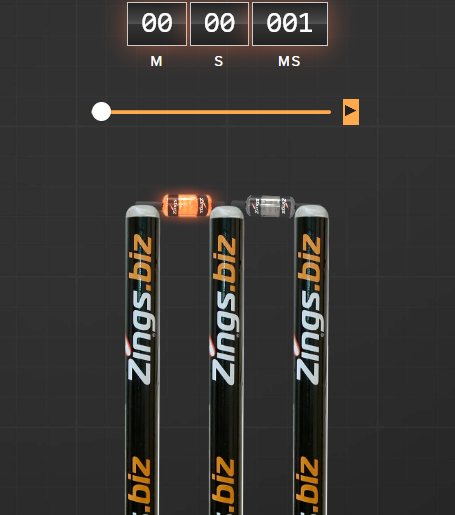
Zings IPL stumps are expensive because they are not simple wooden sticks but they are high-tech devices packed with electronics, sensors, and microprocessors. Here are the main reasons why IPL wickets are expensive:
Advanced Sensor Technology
- Each bail and stump has microprocessors and sensors that detect even tiny movements when the bail is dislodged.
- They trigger LED lights within 1/1000th of a second that help umpires make precise decisions in tight run-outs and stumpings. These stumps cost 5 times of the normal wooden stumps
LED Lights and Electronics
- The stumps and bales contain LEDs, batteries, and radio transmitters.
- When the bail comes off, it sends a signal to light up the stumps instantly.
Special Materials
- Instead of traditional wood, they’re made from durable composite plastics that can handle high-speed balls.
- The design must protect the electronics while ensuring that they break or light up correctly.
Broadcast and DRS Tech
- The LED stumps in IPL work alongside systems like UltraEdge and Hawk-Eye as part of the Decision Review System.
- You may have heard MS Dhoni, Rohit Sharma, and others speak through stump cameras and microphones, which increase production and integration costs.
Complex Manufacturing and Maintenance
- The technology is specialized and produced by a limited number of suppliers (like Zing International).
- The manufacturing process is intricate, and regular maintenance, testing, and replacements drive up the total cost.
Leasing Model
- Boards like the BCCI usually lease the full wicket system (stumps, bails, and electronic base) rather than buying it outright.
- It’s a niche product used only at the highest levels of cricket, so there are no economies of scale like in mass-produced gear.
Because of all this, one set of IPL LED stumps costs roughly ₹33–35 lakhs, making them among the most expensive pieces of equipment on a cricket field.
Who Invented LED Bails for IPL Stumps

The idea for LED stumps and bails came from Bronte Eckermann, a former club-level cricketer and engineer from Australia. A light-up toy his daughter owned inspired him, leading him to believe that cricket could benefit from something similar.
Together with his business partner David Leggittwood, he started a company called Zing International to make these flashing wickets. Australia’s Big Bash League was the first to use the technology, which later gained popularity in other major tournaments. The IPL began using LED stumps and bails regularly from the 2016 season.
How Does the Technology Behind IPL LED Stumps Work?
The LED stump system used in the IPL is built around a smart interaction between the bails, the stumps, and a wireless signal system. The following video explains step-by-step how LED stumps work:
- Each bail contains a microprocessor, sensors, LED lights, and a low-voltage battery inside a durable plastic casing.
- At the start of play, the bails sit securely in grooves on top of the stumps. In this position, the sensors and microprocessor treat it as the normal locked state, meaning the wicket is intact.
- When the ball, bat, or a fielder hits the stumps, even a small lift or shift of the bail is detected by the sensors inside it.
- As soon as the bail loses contact with the stump grooves beyond a set threshold, the microprocessor recognizes that it has been dislodged.
- The moment dislodgement is detected, the microprocessor sends an instant command to switch on the LEDs inside the bail.
- At the same time, the bail sends a wireless signal to the stumps so that the LEDs in the stumps also light up in sync.
- This entire detection and lighting process happens in about 1/1000th of a second, creating the instant flash you see when the wicket is broken.
- The ultra-fast response allows cameras and third umpires to pinpoint the exact frame when the bails first light up which helps in umpiring decisions.
- The stumps and bails are made from composite plastic, not wood, to protect the electronics and withstand the impact of quick deliveries.
- Before every match, technicians and officials test the sensors, LEDs, batteries, and signal connection to make sure the entire system is working perfectly.
Conclusion
LED stumps may look like simple equipment but they are packed with technology that makes umpiring faster and more accurate. So when fans ask, “How Much an IPL Stump Cost?” The answer is that you are really paying for the whole system of lights, sensors, and smart bails.
These stumps have helped cricket look more modern and made close moments in the IPL clearer and more exciting to watch. However, as I said, it is hard to buy a complete set of bails as the maintenance and technical costs are way too high. I hope you like this article and it helps you to understand how these LED wickets work and the technology behind them.